Stop pasting your dissertation into someone else's server.
Arclyne is a local AI research assistant. Drop in papers, lectures, and your Zotero library. Ask anything. Every answer is cited. Nothing leaves your machine.
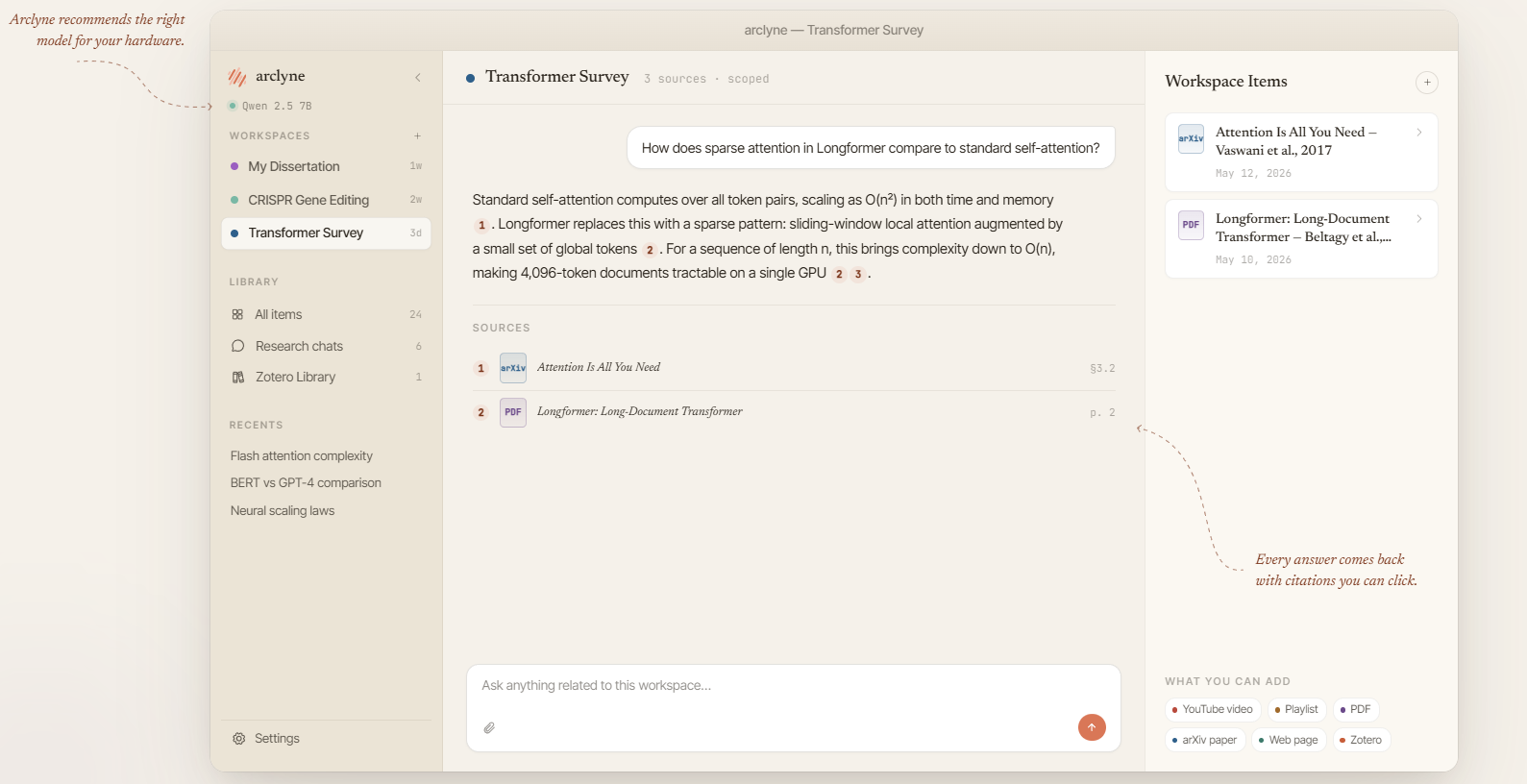
How does sparse attention in Longformer compare to standard self-attention?
Ask anything related to this workspace…
Workspace Items
arXiv
Attention Is All You Need — Vaswani et al., 2017
May 12, 2026
PDF
Longformer: Long-Document Transformer — Beltagy et al., 2020
May 10, 2026
Drop a file or paste a URL
⌘V works too
What you can add
YouTube videoPlaylistPDFarXiv paperWeb pageZotero
Arclyne recommends the right model for your hardware.
Every answer comes back with citations you can click.
The unspoken cost
Every time you paste an unpublished draft into a cloud model, you're publishing it.
Most research tooling treats your sources, your highlights, and your half-formed ideas as raw material to send somewhere else. We thought the better default was for none of it to leave your machine in the first place.
Why Arclyne exists
Built for the way researchers actually work.
A paywalled subscription
Buy it once. Own it.
Your chats live on someone's server
Your chats live in ~/Library.
Models change overnight under you
You pin the model. Forever if you want.
PDFs uploaded into a black box
PDFs parsed locally — see every chunk.
The product
Designed like a tool you'll actually keep.
Three quiet decisions that make the difference between a chat box and a research environment.
Six source types
Six kinds of source. One kind of conversation.
Drop a PDF, paste an arXiv ID, link a lecture, import your entire Zotero library, save a web article, or queue a full YouTube playlist. Arclyne handles parsing, transcription, and embedding locally — and every source ends up in the same searchable workspace.
arXiv paper
Resolves metadata, authors, and abstract from arXiv. Fetches and summarises the full PDF.
PDF document
Full text extracted locally. Scanned PDFs detected and flagged automatically.
YouTube video
Audio extracted and transcribed locally, indexed by timestamp.
YouTube playlist
Each video becomes its own source. Processed sequentially in the background.
Web page
Saved offline in reader mode. Stays even if the original disappears.
Zotero library
One-click sync. Your existing collections become workspaces.
Add to library
What are you bringing in?
arXiv
arXiv paper
2310.06825 · 22 pages
PDF
PDF document
efficient_transformers.pdf
YT
YouTube video
18:34 · auto-detected en
PL
YouTube playlist
8 videos · 2h 14m · queued · background
W
Web page
reader mode · saved offline
Z
Zotero Library
1,242 items · 14 collections
Workspaces with citations
Answers grounded in your sources. Always.
Workspaces scope every chat to a focused container of sources you're actively reading together. The model grounds every answer in your sources — and flags when the answer isn't supported by what you've uploaded.
Scoped chat
Every conversation is bound to a workspace, so answers never wander.
Inline citations
Each claim links back to the page, paragraph, or video timestamp.
Hallucination filter
If the answer isn't supported by your sources, Arclyne tells you.
Transformer Survey · scoped chat
What problem does sparse attention solve?
Standard self-attention scales as O(n²). Longformer's sparse pattern reduces this to O(n), making long documents tractable12.
Sources
1
arXiv
Attention Is All You Need§3.2
2
PDF
Longformer: Long-Document Transformerp. 2
Privacy that is not a marketing claim
Your sources never leave the machine.
No cloud upload. No backend account. No 'we anonymize before storage' weasel-words. The model is a Llama.cpp sidecar running on your own GPU or CPU. The vector index sits in your local app data folder. The only network call Arclyne makes is to check for updates — and you can turn that off too.
Offline by default
Arclyne works perfectly with the Wi-Fi switched off.
Arclyne picks your model
Hardware-matched during onboarding — Qwen, Llama, Gemma ready to go.
Audit-friendly
Per-source processing log shows every chunk, every embedding call.
Open file format
Index stored locally in an open format. Your data belongs to you, not us.
Network log · this session
✓14:08:02parsed2310.06825.pdf· local
✓14:08:14embedded412 chunks· nomic-embed · local
✓14:09:11chatQwen 2.5 7B· llama.cpp1.4s
—— outbound bytes ——
0bytes sent during this session
Six source types
Six kinds of source. One kind of conversation.
Drop a PDF, paste an arXiv ID, link a lecture, import your entire Zotero library, save a web article, or queue a full YouTube playlist. Arclyne handles parsing, transcription, and embedding locally — and every source ends up in the same searchable workspace.
arXiv paper — Resolves metadata, authors, and abstract from arXiv. Fetches and summarises the full PDF.
PDF document — Full text extracted locally. Scanned PDFs detected and flagged automatically.
YouTube video — Audio extracted and transcribed locally, indexed by timestamp.
YouTube playlist — Each video becomes its own source. Processed sequentially in the background.
Workspaces with citations
Answers grounded in your sources. Always.
Workspaces scope every chat to a focused container of sources you're actively reading together. The model grounds every answer in your sources — and flags when the answer isn't supported by what you've uploaded.
Scoped chat — Every conversation is bound to a workspace, so answers never wander.
Inline citations — Each claim links back to the page, paragraph, or video timestamp.
Hallucination filter — If the answer isn't supported by your sources, Arclyne tells you.
Privacy that is not a marketing claim
Your sources never leave the machine.
No cloud upload. No backend account. No 'we anonymize before storage' weasel-words. The model is a Llama.cpp sidecar running on your own GPU or CPU. The vector index sits in your local app data folder. The only network call Arclyne makes is to check for updates — and you can turn that off too.
Offline by default — Arclyne works perfectly with the Wi-Fi switched off.
Arclyne picks your model — Hardware-matched during onboarding — Qwen, Llama, Gemma ready to go.
Audit-friendly — Per-source processing log shows every chunk, every embedding call.
Open file format — Index stored locally in an open format. Your data belongs to you, not us.
Honest comparison
Different tools, different bargains.
Arclyne isn't trying to be a frontier model. It's trying to be the tool you can leave open while you read.
Arclyne
Elicit
NoteGPT
NotebookLM
Runs entirely on your machine
—
—
—
No subscription. One-time fee.
—
—
—
Cited answers from your sources
partial
Workspaces with scoped chat
partial
—
partial
arXiv import
—
—
PDF text extraction
partial
partial
YouTube + playlist transcripts
—
partial
Zotero library import
—
—
—
Works offline / on a plane
—
—
—
Pricing
Own the tool. Not the subscription.
One payment. Used to be the way software worked. We brought it back.
Personal license
$49once, not per year
14-day free trial, no credit card. Cancel by never giving us one. Buy when you're sure.
Academic pricing - 30% off. Email edu@arclyne.com from your .edu address and we'll send you a discount code.
What you get
Unlimited workspaces and sources
All six source types — arXiv, PDF, YouTube, playlist, web, Zotero
Per-paragraph citations on every answer
Vision model support — ask questions about figures and charts
Full PDF text extraction, scanned PDF detection
arXiv import with metadata and author extraction
Lifetime updates on the 1.x series
Personal-use license, two machines
30-day no-questions-asked refundLifetime updates on 1.xPersonal use, two machinesTeam licenses on request
Frequently asked
The questions we hear most.
Any Windows or Mac machine from the last few years. The lightest models (Qwen 2.5 1.5B, Llama 3.2 3B) run fine on 8 GB RAM — enough for a MacBook Air or a mid-range Windows machine. 16 GB gives you access to mid-size models like Mistral 7B and Llama 3 8B. 32 GB or a dedicated GPU opens up the larger research-grade models.
No questions asked. If you buy Arclyne and decide it's not for you within 30 days, email support@arclyne.com and we will process a full refund. No forms, no hoops.
Yes. Your personal licence covers up to two machines you own. You can activate and deactivate machines from the Settings panel inside the app at any time.
No — and that's the whole point. Arclyne is built around local models precisely because your research shouldn't leave your machine. If you want cloud AI quality, you already have ChatGPT. Arclyne gives you something different: a model running entirely on your hardware, with no data leaving your device.
We're a small team. We wanted the Mac build to feel genuinely native, and that takes time to get right. Enter your email in the form above and we'll notify you the moment it ships.
It stays on your machine in %APPDATA%\Arclyne on Windows. Delete the folder yourself if you want it gone. We never held a copy.
For most research tasks — summarization, cross-referencing, quote retrieval, extraction — yes. For frontier-grade reasoning on hundred-page documents, no. Arclyne's bargain is a smaller, trustworthy model grounded entirely in your actual sources. Every answer is cited. Nothing is invented.
Yes. Email support@arclyne.com with a brief description and we'll send back pricing. We have a particular soft spot for university libraries.
Ready when you are
Stop pasting your work into a stranger's server.
Download Arclyne, drop in the first paper you've been meaning to read, and ask it something only you would think to ask.